 Common
 Polar Regions
Tundra Swan
Cygnus columbianusGreen
The Tundra Swan covers astonishing distances between Arctic breeding grounds and temperate wintering areas, traveling in family groups whose calls can carry far across cold sky and open water. In flight, the long neck stays straight and the wingbeats create the steady, whistling rhythm that gave the species one of its older common names.
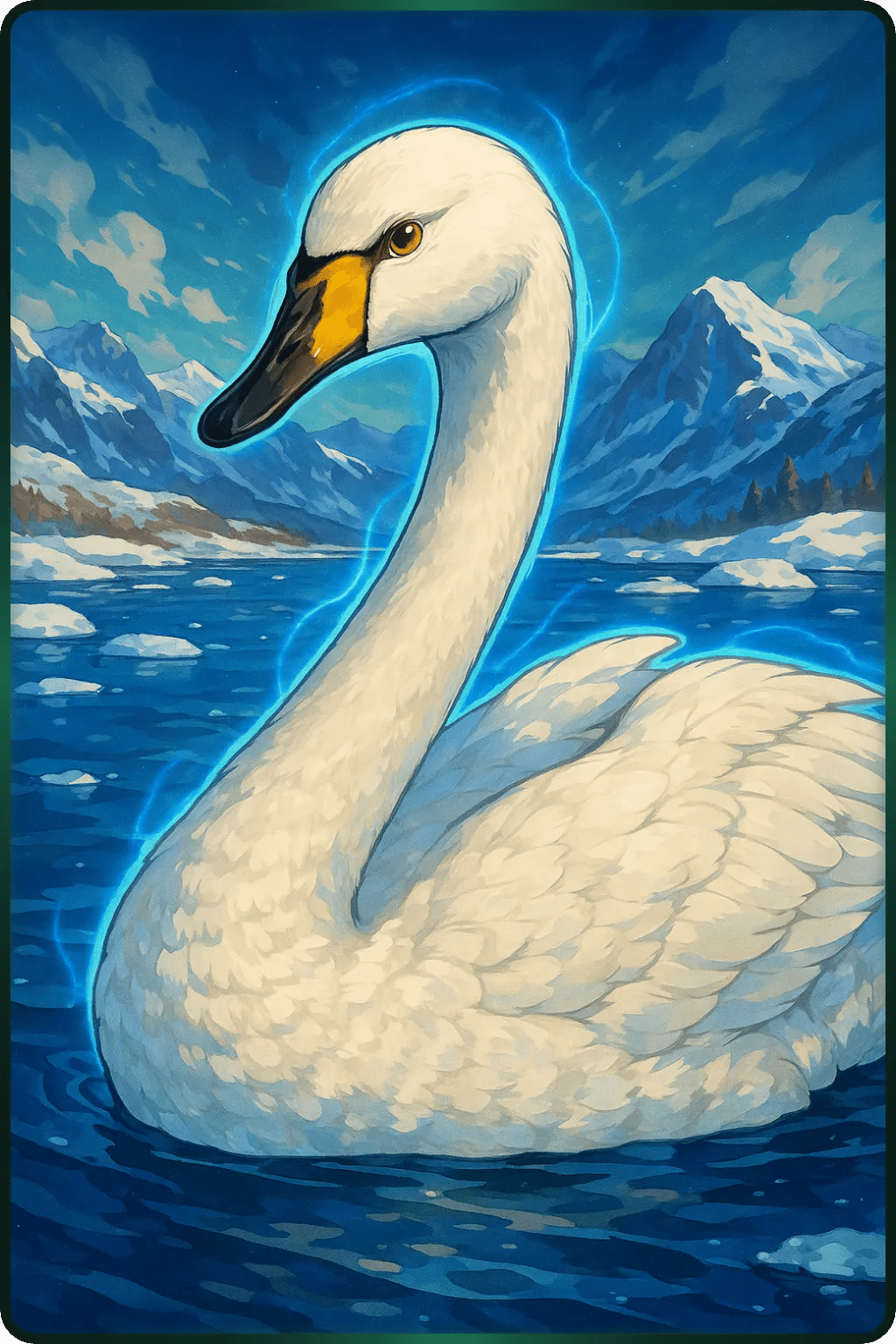 CommonTundra Swan
In battle
- HP
- 2,550
- ATK
- 2,400
- DEF
- 2,500
- Energy cost
- 3
Passive Skills
- ATK and DEF +10% (50% max) each time the animal is hit
- On the 1st appearance, damage reduction +30%
- For each energy point attached during the round, ATK +30% and damage reduction +10%
Attack Effects
- Self: 50% chance to trigger • DEF +30% (3 rounds)
The animal behind the card
On wetlands and flooded fields it feeds mainly on aquatic vegetation, roots, and other plant matter, tipping and probing in shallows with deliberate efficiency. Pairs are strongly bonded, and during the breeding season they defend nesting territories on remote northern tundra with far more intensity than their graceful appearance suggests.
Because these swans rely on chains of safe stopover wetlands during migration, their journeys depend on habitat quality over vast distances rather than in one place alone. Healthy tundra swan populations show how tightly Arctic breeding systems and southern winter refuges remain connected.
Bestiary facts
A whooper swan's long windpipe loops inside its breastbone, amplifying its trumpet-like call.
- Body length
- 1.2–1.5 m
- Weight
- 5.9–9.1 kg

Chemistry links
- Conservation
- Least Concern
- Remarkable Ability
- Long-Distance Flight
- Feeding Mode
- Herbivore
- Behavioral
- Monogamous Pair
- General Physical
- Bony Endoskeleton with Jointed Limbs
- Intermediate Physical
- Feathered Wings
- Specific Physical
- Webbed Feet
CommonTundra Swan CommonDuckling
 Rare
Rare
 Legendary